
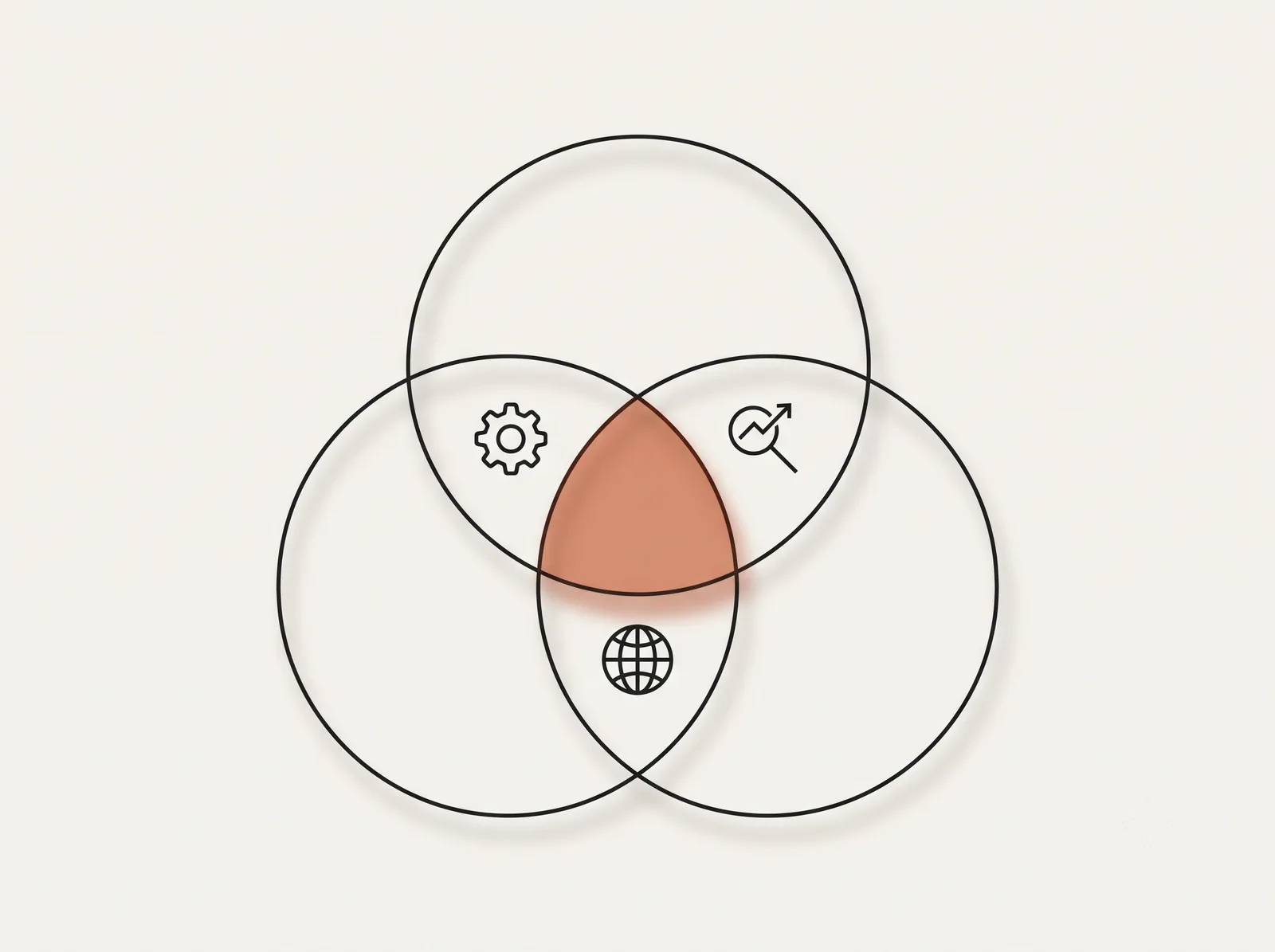
TL;DR: SEO is not dead. AEO (answer engine optimization) and GEO (generative engine optimization) are two names for the same shift: being named inside an AI answer rather than ranking below it. Both sit on top of SEO. The work overlaps; the measurement is what really changes.
Last updated: 18 September 2026.
Three acronyms are being used for roughly the same change. SEO you already know. AEO stands for answer engine optimization, GEO for generative engine optimization. Both newer terms describe one goal: getting your business named inside the answer an AI assistant gives your buyer, instead of only appearing in a list of links below it.
The headlines saying SEO is dead are wrong, though they point at something real. The way buyers find businesses has changed, while the foundation underneath has not.
Key takeaways
- SEO is not dead. AI answers are built from pages that search engines and AI crawlers can find, read and trust, which is what SEO produces.
- AEO and GEO are two names for the same shift: being named inside the AI answer rather than ranking below it.
- Both sit on top of SEO: same foundation, plus answer-first pages, structured data, AI-crawler access, presence on the sources AI cites, and tracking what AI says.
- Measurement changes more than the work does. You now also need to know whether you are named, in what position, and which sources were cited.
- Google's published guidance on AI-assisted content is about quality and helpfulness, not about how a page was produced.
What do SEO, AEO and GEO actually mean?
In one line each: SEO gets your page ranked in a list of search results, AEO gets your content used as the direct answer to a question, and GEO gets your business named inside an answer that an AI model writes. All three depend on the same underlying thing, which is content a machine can find, read and trust.
SEO: search engine optimization
SEO is the work that makes your pages rank in search results. It covers what your pages say, how your site is built, how quickly it loads, and how many credible sites point at you. The buyer sees a link, clicks it, and lands on your site. For the full breakdown, see our guide to what search engine optimization is.
AEO: answer engine optimization
AEO is the work that makes your content usable as an answer. An answer engine wants a clean, direct response to a specific question, in a form it can lift. So the question is asked plainly on the page, the answer follows immediately, and the page is marked up so a machine can tell what it is looking at. Our guide to what answer engine optimization is walks through it in full.
GEO: generative engine optimization
GEO is the work that makes a generative assistant name your business when it writes an answer. The assistant is composing a paragraph and deciding which businesses to mention in it. That decision draws on your own pages plus the third-party sources it trusts, such as directories, review platforms, trade publications and community discussions. See our full guide to what generative engine optimization is for a deeper walkthrough.
My own view: the split between AEO and GEO is mostly about which system the speaker has in mind, and the practical work is close to identical. If a provider says they are separate disciplines, ask which tasks actually differ.
Is SEO dead now with AI?
No. SEO is not dead. AI assistants build their answers from web pages, and the pages they draw on are indexed, readable, well structured and credible. Those are SEO outcomes. What changed is that ranking well is no longer the whole job, because a buyer can get an answer without ever seeing a list of links.
Here is the honest version. Some results now end with an answer instead of a click, so for questions settled in a sentence, fewer people click through. For questions that end in hiring someone, the buyer still has to reach a real business, and that business has to exist somewhere the AI can find it.
The real risk is a measurement one. You watch only clicks, see them dip on informational pages, and write off the whole channel while you are quietly left out of the answers that matter.
Is SEO still worth it in 2026?
For most businesses, yes, because the work now has two payoffs. The page that ranks in Google is also the page an AI assistant reads when it decides who to recommend. One piece of work, two places it can show up, provided it answers a real buyer question clearly. Our playbook on running SEO and GEO together shows how to cover both without doubling the work.
What changes is what you publish. Generic pages that repeat what everyone else says were always weak, and they are weaker now, because an AI answer can summarise that material without sending anyone to your site. Pages carrying something specific still earn the click: your process, your pricing logic, your service area, your real constraints.
One fair limitation. If your buyers rarely search at all and come entirely from referrals, this may be a low priority for you. Check your own enquiry sources before spending anything.
Will AEO replace SEO?
No. AEO adds to SEO. An answer engine cannot quote a page it cannot crawl, cannot parse, or does not trust, and everything that makes a page crawlable, parseable and trustworthy is SEO work. AEO is the layer on top: shaping the page so the answer is easy to extract, and making sure the question your buyer asks appears on the page in their words.
Think of it as an order of operations. The page has to be reachable, then correct and useful, then formatted so a machine can take the answer out of it cleanly. Jumping to the third step on a site AI crawlers cannot read achieves nothing.
What AEO adds on top of SEO
- Pages built around one real buyer question, answered in the first two or three sentences.
- Headings written as the questions people ask, not as clever titles.
- Structured data so machines can classify the page: a service, an article, a set of questions and answers, a location.
- Access for AI crawlers, since plenty of sites block them without knowing it.
What's the difference between SEO and GEO?
SEO optimises for a ranked list of links. GEO optimises for a written answer that names businesses. With SEO the buyer picks from your result and several competing ones. With GEO the assistant has already narrowed the choice, so you are either inside that shortlist or invisible. The content work overlaps heavily; the target and the measurement differ.
| SEO | AEO | GEO | |
|---|---|---|---|
| Goal | Rank in the list of search results | Be the extracted answer to a question | Be named inside a generated answer or recommendation |
| Where the buyer sees you | A blue link on a results page | A direct answer box or AI summary at the top | Inside the assistant's written reply, alongside two or three others |
| What you optimise | Content depth, site health, internal links, credible links in | Answer-first structure, question phrasing, structured data, crawler access | All of the above, plus the third-party sources the assistant cites and how consistently your business is described across the web |
| How you measure it | Rankings, impressions, clicks, enquiries | Whether your page is the one quoted, and whether it still earns the click | Whether you are named at all, where you sit among the businesses mentioned, and which sources the answer cited |
That last row is where most businesses are unequipped. A rankings tool cannot show AI mentions, because there is no ranking to read. You have to ask the engines your buyers' questions and record what comes back.
What is AI SEO called now?
There is no agreed name. You will see AEO, GEO, AI SEO, AI search optimization and AI visibility used for overlapping work. None is an official standard, and no search engine has endorsed a term. Pick whichever word your team understands, then judge a provider on the work they describe rather than the acronym.
This matters commercially, because an ordinary content package can be relabelled as GEO and repriced. The useful question is which AI engines a provider checks, how often, and what happens when a competitor gets recommended instead of you. Our guide to an AI visibility team versus an SEO agency versus an AI content tool compares what each type delivers.
One caution on tactics, per engine
Google has publicly played down several tactics sold under the GEO and AEO labels, such as chopping content into tiny passages or adding special AI-only files, and says its systems read normal prose. Those tactics may still help with other assistants, so scope the claim to the engine before you spend money. Google's AI features guidance and helpful content guidance are short enough to read yourself.
What changes when you measure it?
Measurement is the biggest practical change. Rankings and clicks still tell you how search is going, and they say nothing about whether an assistant recommended you. You need a second set of numbers, gathered by asking the engines your buyers' questions and recording the answers over time.
What you keep measuring
Impressions, clicks, positions and enquiries from Search Console and your analytics. These stay the ground truth for search demand, and they usually tell you a page is slipping before anything else does.
What you add
Whether your business is named in the answer at all, and where it sits among the businesses mentioned. Which competitors are named instead of you. Which sources the answer cited, because the influence often sits on those sources rather than on your own site.
Why one check is not a measurement
Generated answers vary. The same question asked twice can return different businesses, and answers shift as engines update. A single check is a snapshot. What you want is the pattern over weeks: which questions you are named in, which you are absent from, and which have started to move. Our article on how to read an AI visibility report covers what to look at first.
How do you start with AEO and GEO if you already do SEO?
You do not start over. You add four things: crawler access, answer-first pages for real buyer questions, structured data, and tracking of what AI says. The order below is deliberate, because each step is wasted effort if the one before it is broken.
- Check that AI crawlers can reach your site. Look at your robots rules, any bot filtering at your CDN or firewall, and whether important pages render without JavaScript. A blocked crawler makes every later step pointless.
- Write down the questions your buyers actually ask. Use your sales calls, enquiry forms and Search Console queries. Keep the buyer's wording, clumsy phrasing included. These questions, rather than keyword lists, are what you optimise against.
- Ask the engines those questions and record what comes back. Note whether you are named, who is named instead, and which sources are cited. That record is your baseline.
- Fix the pages you already have. For each question you should own, find the closest existing page, move the direct answer to the top, and add the question as a heading in the buyer's words.
- Add structured data. Mark up your organisation, your services, your locations and your question-and-answer sections so machines can classify the page without guessing.
- Publish pages for the gaps. Where no page exists for a question you should win, write one. One question per page, answered in the opening lines, with the detail underneath.
- Work on the sources AI cites. If the same directories, review platforms or publications keep appearing in the answers you recorded, make sure your business is present there and described consistently.
- Re-check and keep the record. Ask the same questions again on a regular cycle and track the change. Without a repeated check you cannot tell what worked.
Steps 1 through 6 are jobs a competent SEO can do. Steps 3, 7 and 8 get dropped most often, because they are ongoing rather than one-off. For a fuller walkthrough of the publishing side, see how to get your business recommended by AI.
Does Google penalize AI content for SEO?
Google's published guidance is about content quality and helpfulness, not about how the content was produced. There is no rule demoting a page for being written with AI assistance. What gets judged is whether the page is useful, accurate, original in some respect, and genuinely serving the reader. Using automation to mass-produce pages purely to game rankings is treated as spam, which is a separate matter.
The confusion comes from what tends to happen in practice. Bulk-generated pages are usually thin and interchangeable, and thin pages perform badly whoever writes them, including a human on a deadline. Production method is not the variable. Substance is.
Here is the practical test for any page, however it was drafted. Does it answer the question better than the page currently winning it, and does it contain something a summary could not replace? If yes, publish. If no, do not, regardless of who or what wrote it. A human review step before anything goes live is the safeguard most bulk content operations skip.
Frequently asked questions
Can ChatGPT do SEO?
It can help with parts of it: drafting, outlining, spotting gaps in an existing page, rewriting clumsy copy. It cannot see your Search Console data unless you hand it over, crawl your site, or fix technical issues. Treat it as an assistant on the writing, not a replacement for measurement and fixes.
Do I need both SEO and GEO, or can I pick one?
You need both, and in practice they are one programme. GEO without SEO fundamentals fails, because AI cannot read or trust the site. SEO without the AEO and GEO layer leaves you ranking below answers you are never named in.
Is GEO replacing SEO as a service category?
The label is changing faster than the work, and many providers have simply renamed their SEO offering. Judge on scope: which engines get checked, how often, what happens when a gap is found, and who fixes the technical issues. Those answers tell you more than the name on the invoice.
What are answer engine optimization tools?
They fall into three groups: trackers that ask AI engines your questions and record the answers, content tools that help you structure pages as answers, and technical tools that check crawler access and structured data. Most products cover one group, so check what is missing before you buy. A tracker on its own shows the gap without closing it.
How long does it take to show up in AI answers?
It varies by question, by engine and by how competitive your space is. Technical fixes such as unblocking a crawler can take effect quickly once pages are re-crawled, while new pages need to be indexed first. Changes in how often you are named generally build over 2 to 3 months of consistent publishing and fixing.
Should I stop writing blog posts?
Not if they answer questions your buyers genuinely ask before they buy. Stop writing posts that exist only to hit a keyword or to look active. The test is whether a real buyer would ask that question out loud during a sales conversation.
Who should own this work inside a small business?
Whoever owns your website content today, provided they also see the tracking data. The failure mode is splitting it three ways: one person writes, another handles technical issues, and nobody checks what AI actually says.
Where to start
If you have never checked, start there. Find out which of your buyers' questions AI is answering, who it recommends when it is not you, and which sources those answers rely on. That takes an afternoon, and it tells you whether this is urgent or simply worth planning for.
If you would rather have it handled continuously, the Visiby Growth Engine is an AI visibility team assigned to your site. It tracks how five AI engines answer your buyers, fixes what stops AI reading your site, and publishes pages built to close the gaps it finds. It starts at $1,000 a month, no contract, everything created stays yours.
Book 15 minutes and we will walk through what your check found and what the first month would cover: https://orufybookings.com/fna-technology/30-min-intro-call
Or run the free AI visibility check first.
Raunaq Arora
Raunaq Arora is a senior software and AI engineer at Visiby, where he builds the AI-visibility measurement pipeline and dashboard. He writes about how AI-visibility tracking is measured and tooled. Run the free AI visibility check →