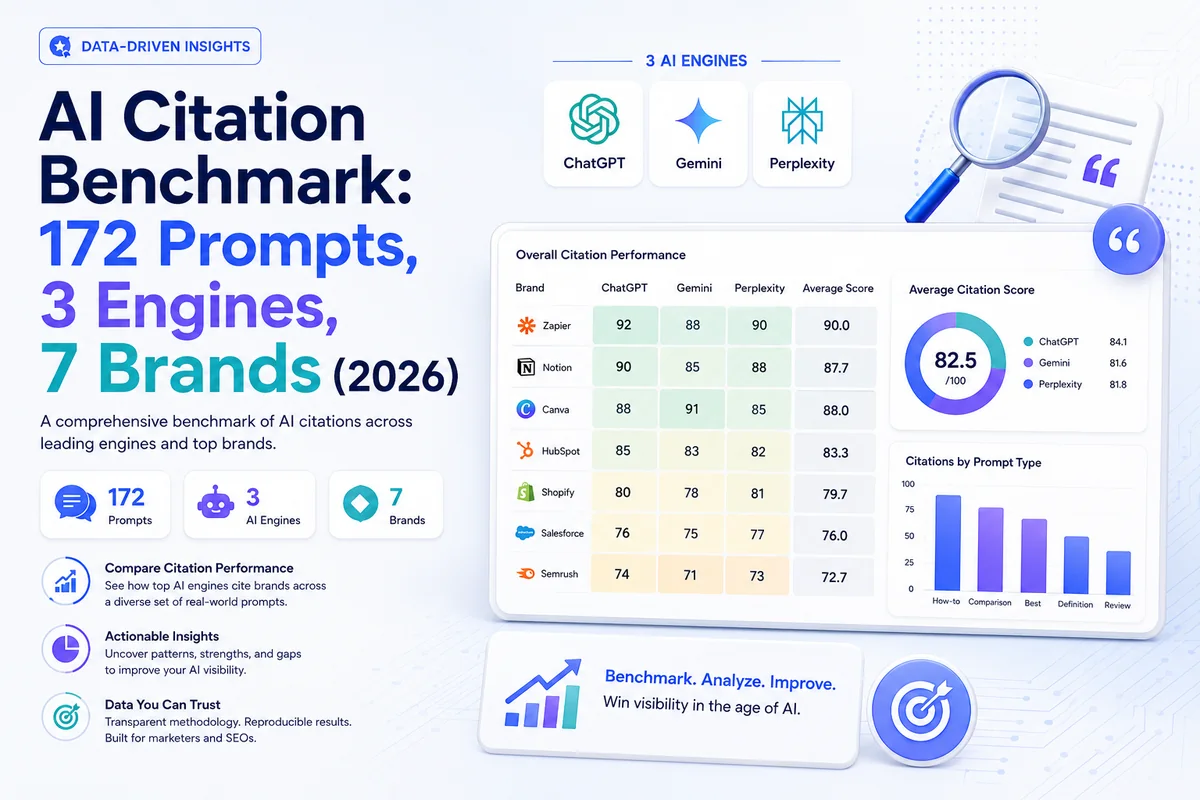

Across 2,443 prompt-runs and 7 brands, the median brand was cited in 11% of ChatGPT answers, 9% of Perplexity answers, and 4% of Google AI Overviews answers — and the same brand's rate swung by up to 24 percentage points between engines.
You cannot read AI visibility off a single engine.
Bottom line up front: Three AI engines. One set of buyer questions. Three completely different citation maps. On one in nine fully-answered prompts, ChatGPT, Perplexity, and Google AI Overviews cited no source in common. If you are only tracking one engine, you are managing a fraction of your AI search visibility — and probably the wrong fraction.
Methodology note: This benchmark is based on original Visiby pipeline data. 2,443 total prompt-runs were executed across ChatGPT, Perplexity, and Google AI Overviews in June 2026 (each of the 172 buyer prompts sampled across multiple independent runs, averaging ~4.7 samples per prompt-engine). Seven real brands were anonymised for the public release. All figures on this page trace to that single pipeline run. The prompts are public; any number is one query away from being verified.
01 — ScopeWhat this benchmark covers
Most claims about AI visibility are anecdotes. This is a log.
In June 2026, Visiby's pipeline ran 172 real buyer prompts through ChatGPT, Perplexity, and Google AI Overviews, then recorded every URL each engine cited — 3,340 citation events across 2,355 URLs from 1,174 domains. ChatGPT answered all 172 prompts, Perplexity all 172, Google AI Overviews 170. A structural validator checked all 9,615 underlying citation claims before anything was aggregated.
Key findings
| Engine | Median Brand Citation Rate |
|---|---|
| ChatGPT | 11% |
| Perplexity | 9% |
| Google AI Overviews | 4% |
- Single-engine tracking is structurally flawed: the same brand's citation rate diverges by up to 24 percentage points across engines.
- Most brands land in single digits on at least one major AI engine.
- Engine divergence is not a rounding error — it is the dominant pattern in the data.
02 — Source OverlapDo the three engines cite the same sources?
They do not.
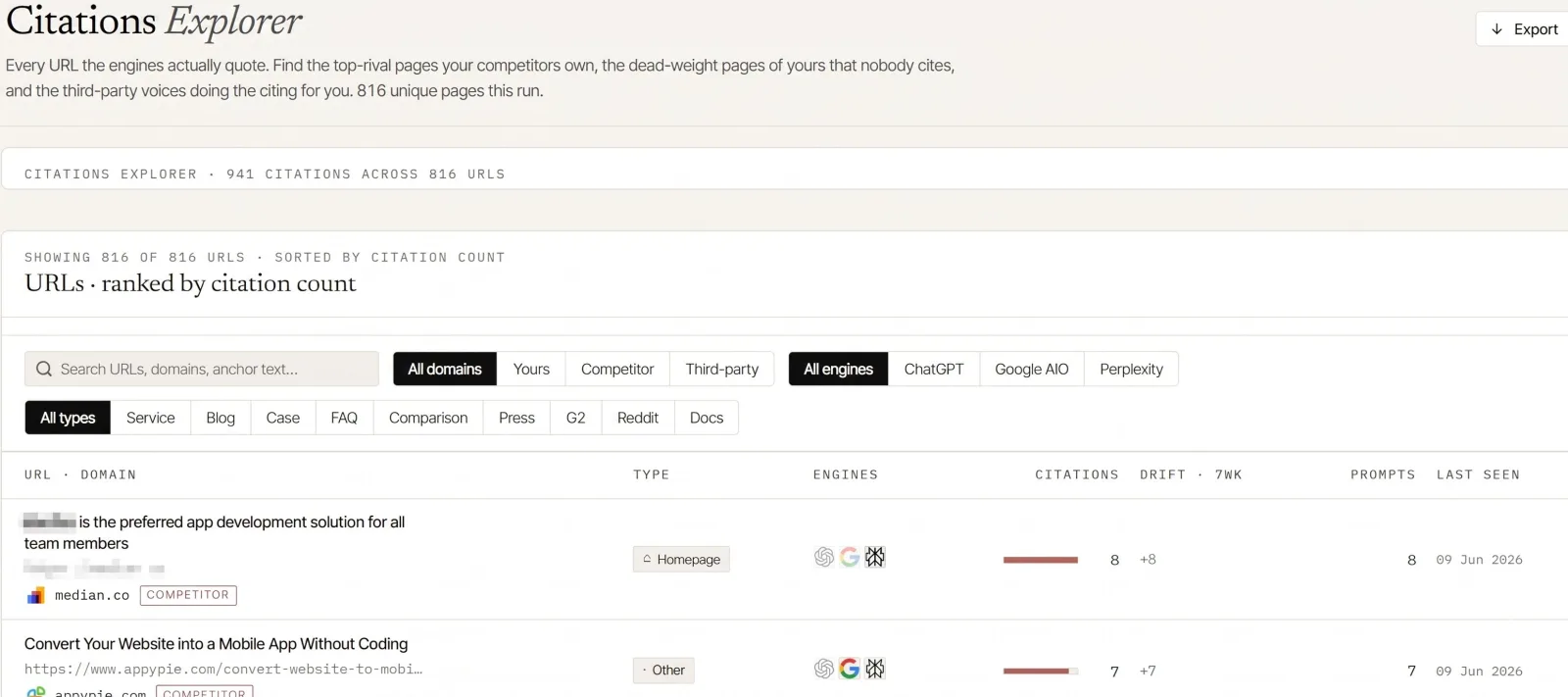
Across 172 prompts, ChatGPT cited 409 unique domains, Google AI Overviews 504, and Perplexity 573 — 1,174 distinct domains in total, with only partial overlap. Perplexity's source universe is roughly 40% larger than ChatGPT's. A brand cited by one engine is frequently absent from the other two entirely.
The clearest way to see this is to follow a single source across the three engines:
| Domain | ChatGPT | Perplexity | Google AI Overviews |
|---|---|---|---|
| 45% (78/172) | 0% (0/172) | 29% (50/172) | |
| YouTube | 0.6% (1/172) | 66% (114/172) | 54% (92/172) |
| SEMrush | 7% (12/172) | 24% (42/172) | 16% (27/172) |
| tryprofound.com | 5% (9/172) | 24% (42/172) | 6% (10/172) |
Reddit is in nearly half of ChatGPT's answers and absent from every single Perplexity answer. YouTube runs the opposite way: two-thirds of Perplexity answers, almost nothing on ChatGPT. These are the same 172 questions hitting wildly different source preferences.
If your AEO or GEO strategy assumes one engine's citation behaviour applies to all three, it is built on a false map.
03 — DisagreementHow much do the engines disagree on the same question?
The headline finding is the disagreement on individual questions.
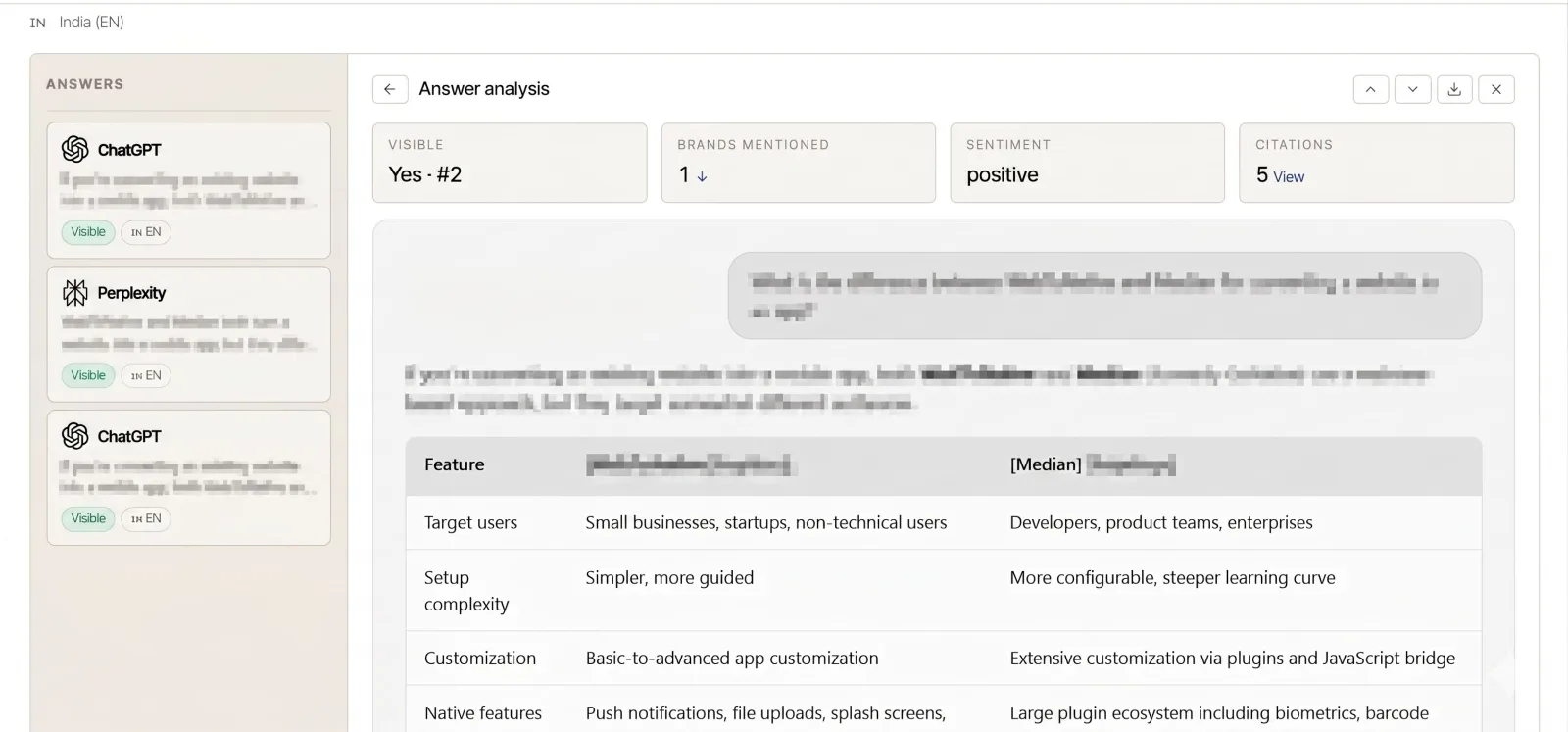
On 146 prompts where all three engines returned cited sources:
- 12% saw all three pairs of engines share at least one domain.
- 77% had partial overlap.
- 11% had zero shared sources — three answers to one question, built on three entirely separate domain sets.
That 11% is the number that should concern anyone tracking a single engine. On roughly one in nine fully-answered prompts, the engines agreed on nothing. Winning ChatGPT's answer for a query tells you nothing about who owns that query on Perplexity.
This holds at the brand level too. Take the most-cited AI-visibility tool in our prompt set, tryprofound.com. Inside the AI Visibility Tracking topic specifically, Perplexity cited it in 24 of 45 prompts (53%); ChatGPT cited it in 5 (11%). The same brand, the same 45 questions — cited 4.7× more often on one engine than the other.
Engine divergence is the dominant pattern, not an edge case.
04 — AuthorityDoes domain authority decide who gets cited?
A counterintuitive result.
We scored the 25 most-cited domains on a 40-point domain authority rubric. YouTube scored 34/40 and Reddit 27/40. Meanwhile, tryprofound.com scored 10/40 — one of the lowest in the entire set. Yet it appeared in 47 of 172 prompts (27%), built on just 17 URLs and 55 citation events.
A domain near the bottom of the authority rubric out-cited most of the field.
Why? AI engines reward topical relevance and content structure, not raw authority alone. A focused page that answers the exact question — with a specific, sourced fact an engine can safely reproduce — beats a higher-authority site that only answers it sideways.
That is good news if you are not yet the biggest name in your category. You do not need to be the most authoritative brand. You need to be the most precisely useful one.
05 — Benchmark RatesWhat a good AI citation rate actually looks like
Based on our June 2026 data across 7 brands and 172 prompts:
| Citation Rate | What it means |
|---|---|
| 0–4% | Effectively invisible on that engine for your category |
| 5–11% | Median range — present but not dominant |
| 12–20% | Strong visibility — cited roughly 1 in 6 to 1 in 8 questions |
| 20%+ | Category leader — usually driven by topical precision, not authority |
The 27% tryprofound.com achieved on a 10/40 authority score represents the upper bound of what is possible for a focused, newer brand. It was built entirely on answering the exact questions buyers ask — not on backlinks, brand age, or domain rating.
06 — MethodologyHow we built it
The method is plain, because the point is that you can check it.
- Mine real buyer prompts. Of the 172 prompts, 127 were harvested live from People Also Ask boxes, forums, and AI Overviews; the rest were written to fill gaps across awareness, consideration, and evaluation stages. These are full questions phrased exactly the way a buyer types them — not keyword stubs. Three from the set:
- "What is a good AI citation rate for my category?"
- "Why is my competitor cited more often than me in AI answers?"
- "How do I become a cited source in Perplexity answers?"
- Run every prompt through all three engines. ChatGPT, Perplexity, and Google AI Overviews — June 2026, US locale. ChatGPT and Perplexity answered all 172; Google AI Overviews answered 170.
- Extract and match every cited URL. Pull each source URL from the answer, resolve it to a domain, count it once per prompt per engine. Result: 3,340 citation events across 2,355 URLs from 1,174 domains.
- Validate before aggregating. A structural validator checked all 9,615 underlying citation claims. None failed. Per-engine citation rate = prompts where the domain was cited ÷ prompts the engine answered.
07 — RecommendationsWhat the data says to do
Track all three engines, always
With 1,174 domains and near-zero overlap on a tenth of questions, a single-engine read is structurally incomplete for most brands. The engine you are not watching is likely running on a completely different source set.
Match your content format to the engine you are losing
Perplexity leans on YouTube (66% of answers) and almost never cites Reddit. ChatGPT leans on Reddit (45%) and almost never cites YouTube. Google AI Overviews sits in between. The fix is not more content — it is the right format for the engine where you are weakest.
| If you're weak on... | Prioritise... |
|---|---|
| Perplexity | Video content, YouTube presence, recently updated pages |
| ChatGPT | Community discussion formats, Reddit-style Q&A, long-form answers |
| Google AI Overviews | Core search ranking signals, structured data, E-E-A-T |
Win the exact question before chasing authority
A 10/40 domain reached 27% citation share by answering the precise prompt with a specific sourced fact. That is the repeatable pattern: find the exact question, answer it completely, give the AI engine something it can reproduce without guessing.
A 2023 Princeton study (Aggarwal et al., arXiv:2311.09735) tested optimisation tactics across 10,000 queries and found that adding statistics, citations, and direct quotations were among the strongest signals for getting a source pulled into an AI answer — lifting visibility by up to 40%. Google's own generative AI documentation says the same: genuinely useful content influences AI presence more than any markup trick, and AI Overviews still grounds on core Search ranking signals.
A note on our own baseline
When we ran this pipeline against Visiby, we were cited in 0 of 172 prompts on all three engines, with a brand-entity score of 8 out of 100 against Profound's 52. That zero is a first-run baseline for a young brand — not a market rate. It is exactly why we built this benchmark. You cannot close a gap you have never measured.
08 — ConclusionConclusion
I ran these 172 prompts expecting the engines to mostly agree. They did not.
ChatGPT trusts Reddit and ignores YouTube. Perplexity does the reverse. On one prompt in nine, they cite nothing in common. The same brand gets cited 4.7× more on one engine than another — for the exact same questions.
The practical takeaway is short: pick a real set of buyer questions, run them through all three engines, log who gets cited, and work on the engine where you are weakest. Because the one you are not watching is running on a different map entirely.
09 — FAQFrequently asked questions
Arun Pandit is the founder of Visiby, an AI-visibility tracker by FNA Technology that measures how often ChatGPT, Perplexity, and Google AI Overviews cite a brand. He writes about generative engine optimization from the data Visiby collects across the brands it tracks. View full profile →