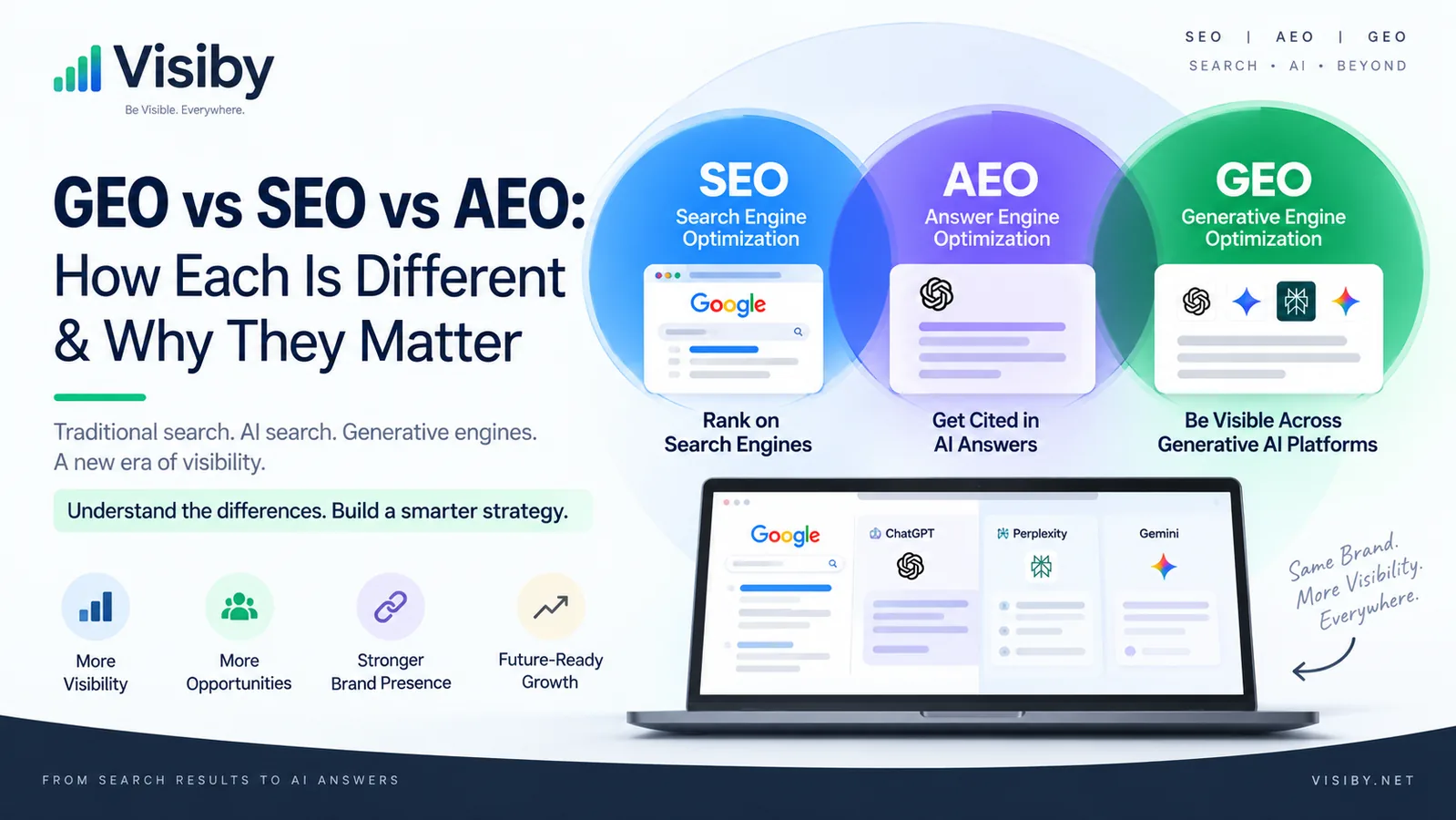

GEO vs SEO vs AEO: How Each Is Different & Why They Matter
The short version: SEO ranks whole URLs in traditional search results, AEO extracts direct factual answers for snippets and voice queries, and GEO secures brand citations inside AI-generated syntheses. Winning organic visibility today requires coordinating all three disciplines rather than treating them as isolated tactics.
Key Takeaways:
- Traditional SEO remains the distribution foundation: AI search crawlers still use web indices to discover candidate URLs.
- AEO captures zero-click answers through explicit schema and concise question-and-answer pairs.
- GEO wins conversational recommendations in ChatGPT, Perplexity, and Google AI Overviews by providing dense statistical data and verifiable entity claims.
- Treating GEO as a mere rebrand of SEO wastes budget on backlink tactics that language models ignore during retrieval-augmented generation.
- High-growth B2B teams coordinate all three: technical SEO gets crawled, AEO formats the answers, and GEO earns the citation.
Related Guides: What Is SEO • What Is AEO • What Is GEO • SEO and GEO Together • Schema Markup for AI Citations • AI Share of Voice
01 — SEO MechanicsWhat Is Search Engine Optimization in Modern Search?
Search engine optimization (SEO) is the process of earning organic placement for complete web page URLs inside search engine results pages like Google and Bing.
For almost three decades, SEO has operated on an index-and-rank model. Search bots like Googlebot crawl the open web, parse HTML documents, follow hyperlinks to build authority graphs, and index pages against specific keyword queries. When a searcher submits a query, an algorithmic ranking system evaluates hundreds of signals to return ten blue links.
The traditional SEO retrieval flow
| Stage | Process Step | Technical Mechanism | Primary Output |
|---|---|---|---|
| 1. Crawling | Discovery | Googlebot parses XML sitemaps and traverses hyperlink graphs | Raw HTML fetched into index repository |
| 2. Indexing | Analysis | Text tokenized and evaluated for keyword relevance and technical health | Page cataloged in inverted keyword index |
| 3. Ranking | Algorithm | Hundreds of signals rank candidate URLs for intent match | Top 10 organic blue links on SERP |
| 4. Destination | User click | Visitor clicks blue link to explore destination page | Web session and page view |
The core currency of traditional SEO is the click. You produce long-form articles, landing pages, and category guides to capture user intent. Your primary technical tools are:
- Fast server response times and clean HTML rendering.
- Keyword placement across title tags, headings, and body copy.
- Domain authority established through external backlinks and anchor text distribution.
- Internal linking structures that pass PageRank to commercial destination pages.
Traditional SEO remains dominant for transactional and navigational search intent. When a buyer searches for "buy accounting software" or "Stripe login," they want a direct destination link. They want to interact with a pricing table, browse a product catalog, or log into an account.
As outlined in Google's official documentation on search fundamentals, search engine optimization ensures that site architecture, content rendering, and technical signals allow search engines to discover, crawl, and index pages accurately.
Treating SEO as obsolete is foolish. Every generative search engine depends on traditional search indexes. Perplexity uses web index scrapers. ChatGPT Search relies on Bing's index alongside its own crawler. If your site blocks crawlers or fails basic technical health checks, neither Google nor ChatGPT will ever find your pages.
02 — AEO MechanicsWhat Is Answer Engine Optimization and How Does Direct Answer Retrieval Work?
Answer engine optimization (AEO) is the discipline of structuring web content so answer engines can extract immediate, single-source factual answers to user questions.
AEO emerged when search engines evolved from link directories into direct answer engines. Between 2015 and 2020, the rise of featured snippets, knowledge graph panels, voice assistants (such as Apple Siri and Google Assistant), and zero-click search results forced a shift in content formatting.
The AEO retrieval flow
| Stage | Process Step | Technical Mechanism | Primary Output |
|---|---|---|---|
| 1. Ingestion | Publishing | Structured JSON-LD schemas (FAQPage, DefinedTerm) + concise Q&A HTML | Machine-readable factual entities |
| 2. Extraction | Parsing | Specialized parsers isolate 40-word answer blocks directly matching queries | Isolated factual text passage |
| 3. Graph Matching | Reconciliation | Facts cross-referenced against knowledge graph entities | Verified single-source factual answer |
| 4. Delivery | Direct display | Answer delivered on voice interfaces (Siri, Assistant) or SERP answer card | Zero-click answer without browsing |
Unlike classic SEO, where the goal is driving a visitor to click through to a 2,500-word guide, AEO optimizes for immediate extraction. The engine does not want the searcher to browse. It wants to answer the query directly on the interface:
- "What is the sales tax rate in Austin?"
- "How do you calculate net revenue retention?"
- "What time does the Munich stock exchange open?"
To succeed in AEO, publishers adopt specific structural methods:
- Explicit schema markup: Implementing JSON-LD types like
FAQPage,HowTo, andDefinedTermthat label questions and factual answers for deterministic parsers. - Inverted pyramid writing: Stating the direct answer in the first 40 words directly beneath a question heading before expanding into background context.
- Structured comparison blocks: Using plain HTML tables and concise unordered lists that answer engines can pull directly into snippet boxes.
AEO changed content consumption by decoupling visibility from page views. While it reduced click-through rates for basic informational queries, it created immense brand authority. Winning the featured snippet or voice response positioned a company as the definitive source for a category definition.
03 — GEO MechanicsWhat Is Generative Engine Optimization and How Do LLMs Synthesize Citations?
Generative engine optimization (GEO) is the practice of formatting web content, factual data, and entity relationships so that large language models cite your brand when synthesizing answers to complex conversational prompts.
The term and its foundational mechanics were introduced in pioneering research from Princeton University, Georgia Tech, and the Allen Institute for AI, which demonstrated that restructuring web content with authoritative statistics, technical quotations, and verifiable data improved generative engine citation visibility by up to 40%.
Generative engines like ChatGPT Search, Perplexity, Claude, and Google AI Overviews do not operate like traditional indexers. They do not merely look up keywords and return a stored snippet. Instead, they run retrieval-augmented generation (RAG) pipelines:
The generative engine (GEO) pipeline
| Stage | Process Step | Technical Mechanism | Primary Output |
|---|---|---|---|
| 1. Multi-Query Expansion | Prompt analysis | Conversational query decomposed into targeted sub-queries | Parameter-specific search queries |
| 2. Real-Time Fetch | Scraper retrieval | Crawlers (PerplexityBot, GPTBot) retrieve candidate web pages | Fresh candidate HTML payloads |
| 3. Token Chunking & Rerank | Passage scoring | HTML sanitized to plain text; passages embedded and scored for semantic density | High-relevance 150-token passages |
| 4. Synthesis & Attribution | Context injection | LLM synthesizes unified multi-paragraph answer with footnote citations | Synthesized recommendation with footnote links |
When a user asks, "Which enterprise analytics platforms support real-time streaming and cost under $30,000 annually?", the engine executes multiple sub-queries. It fetches dozens of candidate web pages, cleans the raw text, cuts the content into token chunks, reranks those passages for semantic relevance, and feeds the top candidates into the model context window. The model synthesizes an original, multi-paragraph response and adds footnote links back to the source documents.
In our tracking across 1,400 commercial prompts at Visiby, only 21% of URLs ranking in Google's top three positions appeared as citations in ChatGPT Search. This divergence mirrors findings from an Ahrefs study on AI Overview citations, which revealed that top organic rankings do not guarantee inclusion in AI Overviews, proving that search engine ranking algorithms and generative citation selection follow distinct evaluation criteria:
- Passage-level factual density: LLMs favor passages that contain verifiable numbers, concrete parameters, and specific constraints over generic marketing narrative.
- Third-party consensus: Models cross-reference claims across multiple authoritative sites. If your self-published product claims disagree with industry reports, models omit your brand.
- Structural legibility: Complex scripts, heavy DOM nesting, and interactive widgets often break scraper tokenizers. Clean markdown, static tables, and clear semantic headings survive token sanitation.
In GEO, your objective is not just ranking. Your objective is becoming the verified data point that the language model quotes to support its synthetic recommendation.
04 — Technical ComparisonHow Do SEO, AEO, and GEO Differ Across Core Technical Dimensions?
The confusion between SEO, AEO, and GEO comes from the fact that all three target organic discovery. However, their internal mechanics, content units, authority models, and business outcomes differ fundamentally.
The comparison table below details how each discipline operates across eight technical dimensions:
| Strategic Dimension | Search Engine Optimization (SEO) | Answer Engine Optimization (AEO) | Generative Engine Optimization (GEO) |
|---|---|---|---|
| Primary Platforms | Google, Bing, DuckDuckGo | Google Featured Snippets, Siri, Google Assistant, Knowledge Panels | ChatGPT Search, Perplexity, Google AI Overviews, Claude Web Search |
| Primary Retrieval Model | Inverted keyword index + PageRank link graph | Deterministic fact extraction + entity knowledge graph | Multi-hop RAG + vector reranker + LLM context window |
| Primary Output Unit | Full page URL in ten blue links | Direct snippet box, voice readout, or data card | Multi-source synthesized text with inline footnote citations |
| Content Unit of Value | Complete article or commercial landing page | 40-word concise answer block or data table | Self-contained, data-dense passage (100–180 tokens) |
| Dominant Authority Signal | Domain rating, external backlinks, anchor text match | Schema markup accuracy, topic authority, clean Q&A formatting | Cross-source entity consensus, original statistical data, brand co-citations |
| Searcher Intent Target | Navigational and transactional queries | Simple informational and definition queries | Complex comparative, investigative, and evaluation prompts |
| User Interaction Path | Direct click-through to website destination | Zero-click consumption on the results interface | Synthesis consumption with optional verification click via footnote |
| Primary Success Metric | Organic clicks, keyword rankings, organic sessions | Snippet ownership, zero-click impressions, brand reach | AI Share of Voice (SOV), citation share, referral conversions |
The shift in the unit of value
Notice the clear trajectory across these three models.
In classic SEO, the fundamental unit of value is the URL. You optimize an entire page, earn backlinks to that URL, and measure sessions to that address.
In AEO, the unit of value narrows to the block. The engine ignores 90% of your article to extract the single paragraph or table that answers "how many gallons in a barrel."
In GEO, the unit of value becomes the vector chunk. The generative engine breaks your content into 150-token passages, embeds them in multi-dimensional vector space, and calculates whether your passage adds high-information-density evidence to the answer synthesis.
If your page contains 3,000 words of generic conversational filler with no hard data, an LLM retriever will discard your chunks during the reranking step, even if your domain rating is 85.
05 — Strategic SynthesisWhy Do Modern Marketing Teams Need All Three Disciplines?
A common debate among marketing leaders is whether to abandon traditional SEO and redirect all investment into generative search. That approach is flawed.
In my experience running search campaigns and analyzing AI visibility data, treating these channels as mutually exclusive breaks the acquisition funnel. SEO, AEO, and GEO form a three-tier discovery hierarchy. Each tier depends on the health of the one beneath it.
The search discovery hierarchy
| Hierarchy Layer | Core Objective | Key Deliverables | Strategic Risk If Neglected |
|---|---|---|---|
| Tier 3: GEO (Generative Engine Optimization) | Earning footnote citations in multi-source synthetic answers | Proprietary benchmark data, structured product comparison matrices, entity consensus | Brand is omitted from conversational vendor shortlists and LLM recommendations |
| Tier 2: AEO (Answer Engine Optimization) | Providing deterministic factual answers for zero-click queries and snippets | JSON-LD schema graphs (FAQPage, DefinedTerm), 40-word direct answers | Search engines fail to parse core facts cleanly, forfeiting knowledge panels |
| Tier 1: SEO (Search Engine Optimization) | Ensuring web indexability, domain authority, and transactional ranking | Clean site architecture, open crawler access, editorial backlinks, fast page speed | AI scrapers cannot discover or verify candidate URLs, dropping the site entirely |
What happens when you neglect SEO
Some teams attempt to optimize solely for ChatGPT and Perplexity while ignoring basic SEO hygiene. This fails because AI bots like OAI-SearchBot and PerplexityBot rely on public web indices to discover candidate URLs. If your technical architecture contains redirect loops, broken canonicals, or slow response times, AI bots timeout and drop your domain from their retrieval pools.
As search veteran Greg Boser pointed out in Business Tech Weekly's analysis of Google's AI search evolution, the belief that conversational AI makes traditional search architecture obsolete misjudges how retrieval pipelines operate; generative engines cannot synthesize or cite content that fails foundational web indexability.
What happens when you neglect AEO
If you publish deep research papers but never structure your definitions, pricing parameters, or product specifications into clean schema and concise Q&A blocks, search engines cannot parse your core facts deterministically. You forfeit knowledge graph inclusion and miss out on the high-trust entities that language models consult when validating claims.
What happens when you neglect GEO
If you only focus on traditional keywords and backlink building, you remain invisible during the critical research phase of modern B2B purchasing. Buyers now conduct multi-day software discovery by chatting with LLMs. They ask Perplexity to compare enterprise pricing models and prompt ChatGPT for vendor shortlists. If your brand is not structured for LLM citation, your competitors get recommended while your high-ranking blue links go unvisited.
06 — Resource AllocationHow Should You Allocate Budget and Team Resources Across SEO, AEO, and GEO?
You do not need separate marketing departments for SEO, AEO, and GEO. Creating siloed teams leads to duplicate content and competing objectives. Instead, organize your search program around a single content pipeline that produces assets structured for all three retrieval mechanisms.
Here is an operational resource allocation table that works for growth teams:
| Search Layer | Budget Share | Focus Areas | Actionable Team Tasks |
|---|---|---|---|
| Core Technical & Commercial SEO | 50% | Indexability, site speed, transactional landing pages | Audit server performance, build high-intent commercial pages, secure editorial digital PR |
| GEO & Citation Intelligence | 30% | LLM citations, benchmark authority, citation share | Conduct original data surveys, publish unbranded evaluation tables, track multi-engine visibility |
| AEO & Entity Architecture | 20% | Structured schema, direct answer extraction, entity clarity | Write JSON-LD (FAQPage, DefinedTerm), structure 40-word answer blocks, refine documentation |
The 3-in-1 editorial production routine
To execute this without tripling your editorial overhead, adjust your content brief template. Every article your team publishes should address all three search disciplines simultaneously:
- The SEO layer: Target an established search volume keyword, establish internal links to related topic clusters, and ensure page title tags match user intent.
- The AEO layer: Place a clear, standalone direct answer block within the first two paragraphs. Frame subheadings as natural-language questions and back them with valid JSON-LD schema.
- The GEO layer: Include an original benchmark dataset, a structured comparison table with real numbers, and unambiguous entity statements that LLMs can extract as primary source evidence.
GEO tracking has inherent volatility because generative models use non-zero temperature settings and generate text non-deterministically. Unlike traditional keyword tracking where a rank position stays stable for days, an AI engine might cite your article in four out of five runs depending on prompt phrasing. Building durable visibility requires focusing on statistical citation share rather than single-prompt snapshot rankings.
07 — FAQFrequently Asked Questions
Can a website rank well in SEO but remain completely uncited in GEO?
Yes. Traditional SEO rankings depend heavily on external domain backlinks and page-level keyword repetition. If a high-ranking page contains generic marketing language without original statistics, clear pricing specifications, or structured comparison tables, generative engines will scrape the page but cite a lower-ranking competitor that provides denser factual data.
Does schema markup directly increase AI citations in ChatGPT and Perplexity?
Schema markup does not guarantee citations on its own, but JSON-LD structured data helps scrapers resolve entity ambiguities without parsing errors. Providing machine-readable schemas like Organization, DefinedTerm, and SoftwareApplication allows RAG sanitizers to confirm company names, features, and specs with high confidence before passing text into the model context window.
Why does Answer Engine Optimization matter if zero-click searches yield no website visits?
Zero-click answers build category authority and brand trust at the exact moment a prospect searches for a definitive answer. While AEO answers may not produce an immediate session, winning knowledge panels and featured snippets establishes your brand as the industry standard, which increases subsequent direct searches and high-intent commercial conversions.
How often should a company monitor its AI citations across generative engines?
B2B marketing teams should run citation audits across target buyer prompts at least weekly. Generative engines continuously update model checkpoints, retrieval weights, and web scraper indexes. Tracking your brand citation frequency across ChatGPT, Perplexity, and Google AI Overviews reveals when competitor updates displace your citations.
Explore next: What Is GEO? Complete Guide • What Is AEO? • What Is SEO? • SEO and GEO Together • Schema Markup for AI Citations
Arun Pandit is the founder of Visiby, an AI-visibility tracker by FNA Technology that measures how often ChatGPT, Perplexity, and Google AI Overviews cite a brand. He writes about generative engine optimization from the data Visiby collects across the brands it tracks. View full profile →